Self-Service Checkout vs Staffed Checkout: Which Is More Profitable for Business
Self-Service Checkout vs Staffed Checkout: Which Is More Profitable for Business
Retail and HoReCa businesses increasingly face the same challenges: long queues during peak hours, rising operational costs, and strong dependence on staff performance. Traditional staffed checkouts are often unable to handle high customer flow efficiently, especially when a business starts to scale.
Self-service checkouts are becoming a practical solution — not as a replacement for people, but as a tool to optimize operations and improve the customer experience.
Key Issues with Staffed Checkouts
Traditional checkout counters are heavily influenced by the human factor. During peak hours, this leads to several systemic problems:
· Long queues and reduced service speed
· Dependence on staff availability and skills
· Errors caused by fatigue and overload
· High operating expenses (salaries, training, staff turnover)
As customer traffic grows, staffed checkouts require hiring additional employees, which increases OPEX and makes scaling more complex.
What Self-Service Checkouts Offer
Self-service checkouts create a standardized and predictable purchasing process. Customers scan items and complete payments independently, while one operator can supervise multiple checkout points at once.
Key benefits of self-service checkouts include:
· 2–3 times faster service speed
· Minimal or no queues
· Fewer operational errors
· 30–50% reduction in operating costs
· Consistent and convenient customer experience
Automation significantly reduces the impact of the human factor and ensures stable service quality regardless of staff shifts or workload.
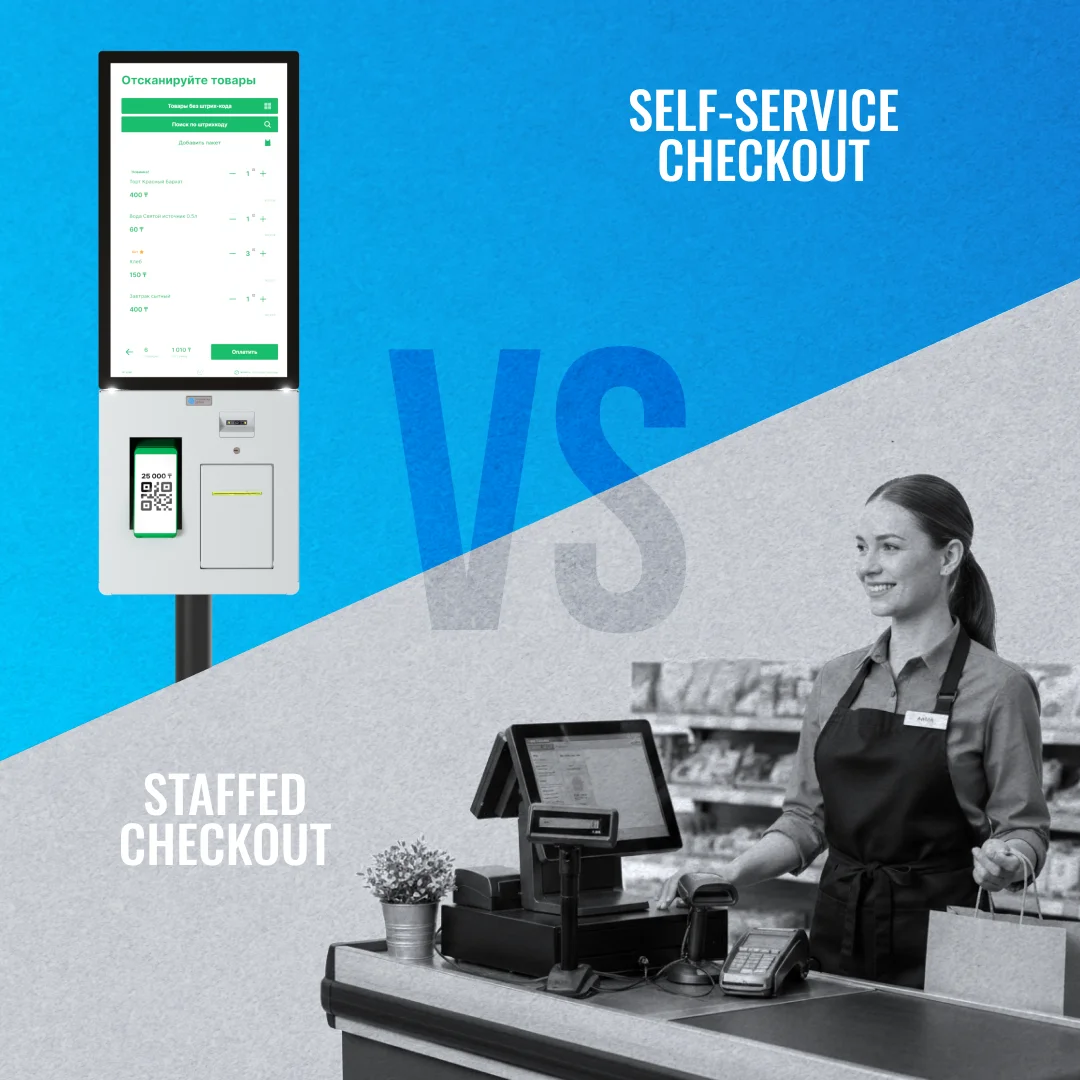
Self-Service Checkout vs Staffed Checkout: Comparison
In terms of service speed, self-service checkouts clearly outperform traditional staffed checkouts. Queues are either significantly reduced or eliminated altogether.
From a cost perspective, self-service checkout systems reduce expenses related to staffing and training, while staffed checkouts require ongoing investments.
Human factor influence is minimized in self-service environments thanks to standardized processes, whereas service quality at staffed checkouts largely depends on individual employees.
Scaling with self-service checkouts is achieved by installing additional kiosks, without the need to expand the workforce.
Where Staffed Checkouts Are Still Necessary
Despite the advantages of automation, staffed checkouts remain essential in certain scenarios:
· Complex transactions
· Customer consultations
· Non-standard service situations
For most retail locations, the most effective approach is a hybrid model, where self-service checkouts handle the main customer flow, while staff focus on assistance and exceptional cases.
Self-Service Checkout Is Not a Replacement for People
Self-service checkout is not about removing people from the process. It is a tool designed for:
· increasing operational efficiency
· business scalability
· cost reduction
· improved customer experience
Automation frees employees from routine tasks and allows businesses to operate more reliably, even during peak demand.